
When we call an agency “independent,” often we mean independence from the executive branch: the president cannot fire its leaders at will. But independence is not a single dial to be turned up or down. Agencies do two different kinds of work —finding facts and deciding what to do about them— and each kind of work faces pressure from different places: the White House, the industries being overseen, and the limits of the agency’s own resources. Hence the question for Congress is often less how independent an agency should be in general than which of its functions need insulation, from what, and by which means. Removal protection is only one of those means, and after this summer’s Supreme Court decision in Trump v. Slaughter (2026), it is now an uncertain one. Rules of process, adequate capacity, and careful placement within government remain available as ways to ensure independence. The National Transportation Safety Board shows how they can be combined to protect the finding of facts while leaving the decisions to officials accountable to voters.
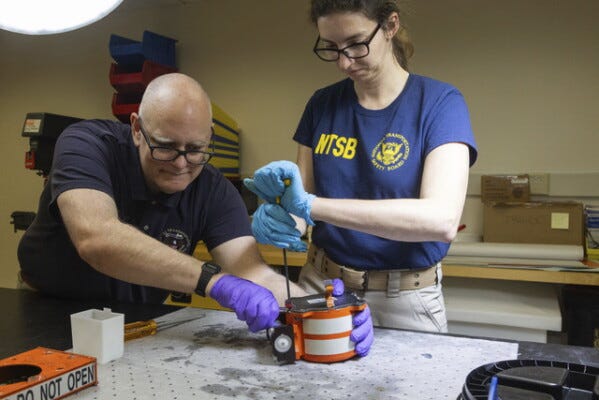
When a plane goes down, a train derails, or a pipeline ruptures, it is the NTSB that arrives at the scene, recovers the recorders, and eventually issues a finding of “probable cause.” Yet the Board cannot ground a single airplane or write a single rule. It issues recommendations. Whether to adopt them is up to the Federal Aviation Administration, the other regulators within the Department of Transportation, and Congress. Of the roughly 14,000 recommendations the Board had issued by 2014, about 73 percent had been adopted in whole or in part. In other words, the NTSB has a great deal of influence and almost no official power.
The NTSB makes plain a distinction that runs through the debate over independence: one kind of work agencies do is producing facts: counting, measuring, forecasting, inspecting, investigating. Another is judging what those facts mean and what should be done about them. An accident investigator and a regulator are both experts, but their work differs in kind. A regulator should arguably be able to decide whether a new safety requirement is worth its cost, but not why the plane went down. The findings of an accident investigation, the measurement of inflation, and the conclusions of scientific review are all candidates for insulation from political authority. Tradeoffs between competing values, by contrast, are closer to choices that many would argue should remain accountable to voters.
Historically, the most common tool for insulating an agency has been a limit on the president’s power to remove its leaders. That tool has recently been thrown into doubt: in Trump v. Slaughter, decided on June 29, 2026, the Supreme Court held 6-3 that for-cause removal protections for Federal Trade Commission commissioners violate the Constitution, overruling Humphrey’s Executor (1935). Supporters of the decision describe it as restoring presidential accountability for the executive branch; critics have raised concerns about the independence of agencies long insulated from political direction. The majority left open one possible exception: an agency that exercises “no part of the executive power” need not fall within the rule of presidential removal. Whether a body that only investigates and recommends could qualify is, as yet, an open question. Hence, whatever one’s view of the decision, removal protection is now an uncertain way to insulate fact-finding.
Other safeguards remain available, and they work differently. The first is process. By regulation, NTSB investigations are “fact-finding proceedings with no adverse parties,” and they do not determine “the rights, liabilities, or blame of any person or entity.” By statute, no part of a Board report may be admitted into evidence in a civil suit for damages arising from the accident. Rules of this kind keep the findings out of the political process, and they protect the facts-finding process regardless of who holds office.
The second is capacity. Independence depends not only on who leads an agency but also on whether it has the resources to do its work. The NTSB has about 440 employees and a budget of roughly $145 million, and it is responsible for investigating every civil aviation accident in the country along with major accidents in other modes of transportation. To manage that workload, it relies on the “party system,” in which the manufacturers, operators, unions, and government agencies involved in an accident, including the FAA, contribute technical staff to the investigation. Lawyers and representatives of claimants or insurers are barred. It is important to note what this means: the agency that investigates the FAA and the companies it oversees relies in part on the FAA and those companies to do so. The parties bring knowledge that no government agency could keep on staff, but the arrangement shows that independence from industry is partly a question of capacity.
The third is location: where within government a function sits, and to whom it reports. The NTSB was created in 1967 as part of the new Department of Transportation, alongside the FAA. As its investigations increasingly implicated the FAA’s own conduct, Congress passed the Independent Safety Board Act of 1974, which declared that “no federal agency can properly perform such functions unless it is totally separate and independent from any other… agency of the United States.” In other words, Congress decided that the investigator could not report to the investigated. It reached a similar conclusion that same year about nuclear power. The Atomic Energy Commission had been charged with both promoting and regulating the industry, and “supporters and critics of nuclear power agreed that the promotional and regulatory duties of the AEC should be assigned to different agencies.” The Energy Reorganization Act of 1974 gave the regulatory half to a new Nuclear Regulatory Commission. When Congress later authorized the Chemical Safety Board in 1990, it followed the NTSB’s model explicitly, making the Board’s investigations “completely independent of the rulemaking, inspection, and enforcement authorities of EPA and OSHA.”
Yet many fact-finding functions remain housed within the departments whose policies their findings bear on. The Bureau of Economic Analysis, which produces the nation’s trade statistics, sits within the Department of Commerce, which also carries out much of the government’s trade enforcement. The Energy Information Administration sits within the Department of Energy. There, Congress chose to protect the function by rule rather than by relocation: the EIA’s administrator need not obtain the approval of any other officer of the department to collect or analyze information, or of any officer of the government to publish the agency’s statistical and forecasting reports. Hence, process can stand in for location, at least in part. Congress could reconsider these placements, or extend protections like the EIA’s to other agencies, although any such change would itself need to account for the Court’s reasoning in Slaughter.
The NTSB, the Chemical Safety Board, and the Energy Information Administration each settle the question of independence differently: the first two by placing the investigator outside the department it investigates, the third by writing rules that protect its findings. None of them depends on removal protection alone. Hence, if the Court’s decision makes it harder to protect an agency’s leaders, Congress may do better to protect the agency’s facts: through rules about how findings are produced and published, through the staff and funding to produce them, and through careful choices about where they are produced. The decisions about what to do with those facts can remain with officials accountable to voters. In other words, independence is not something an agency simply has or lacks, but something built, function by function, out of choices Congress makes at an agency’s conception.