
When members of the public want to check a government decision about a highway, a transmission line, or the use of public land, the debate over their role is usually framed as a single question: should there be more checks or fewer? Some are concerned that a particularly determined executive might steamroll over public rights; others are concerned that public challenges mire efforts to improve public space in costly litigation. Both are concerned with public access to government decisions, and both tend to treat it as a dial between centralization and decentralization. But public access is less a quantity than a structure. It is built from three distinct levers (standing, procedure, and litigation), each set by different institutions and each adjustable independently of the others. Seen this way, the question shifts from how much the public should be able to check the government to which check fits which decision, and at what stage. For permitting, the relevant levers are procedure and litigation. For executive authority over public land, the most important check may lie less with the courts than with Congress.
The first lever is standing: the question of who may bring a case in federal court at all. For example, across much of the American West, the federal government decides not only whether land is protected but whether it can be mined. In the 1980s, the Bureau of Land Management began reopening areas that had long been closed to mining and other private uses, through roughly 1,250 separate decisions. The National Wildlife Federation argued that the bureau had not followed the federal statutes laying out how those decisions were meant to be made. In Lujan v. National Wildlife Federation (1990), the Supreme Court did not resolve that question. Instead, it held that the Federation lacked standing to bring the suit. Its members had said only that they used land “in the vicinity” of the affected areas. In one case, that meant somewhere in a two-million-acre region of Wyoming where about 4,500 acres had been reopened. That, the Court held, was not enough to show that any member would actually be harmed. Nor could the Federation challenge the bureau’s program as a whole. Because standing requirements derive from the Constitution, Congress cannot remove them by statute. Congress can, however, recognize new kinds of injury by statute, and a court might accept a statute recognizing an interest like that of the Federation’s members, although that outcome is uncertain.
The second lever is procedure and approvals: the number of reviews, analyses, and permits a project must obtain. Unlike standing, this lever is not held in one place. It is spread across agencies, commissions, and legislatures at every level of government, and each can stop a project on its own. The experience of Clean Line Energy, founded in 2009 to build five long-haul transmission lines stretching from New Mexico to Tennessee, illustrates this lever. Its projects encountered a denial by Missouri’s utility commission, legislation in Iowa restricting above-ground lines of its type, and the withdrawal of an interconnection agreement in Tennessee. When a group of Arkansas landowners sued, a federal judge rejected their complaint. The company wound down in 2019, after investors had put more than $100 million into it, without completing a line of its own. In Clean Line’s case, then, the decisive steps took place at the approval stage rather than in court, and the obstacle was less any single decision than the number of separate authorities whose approval the project needed.
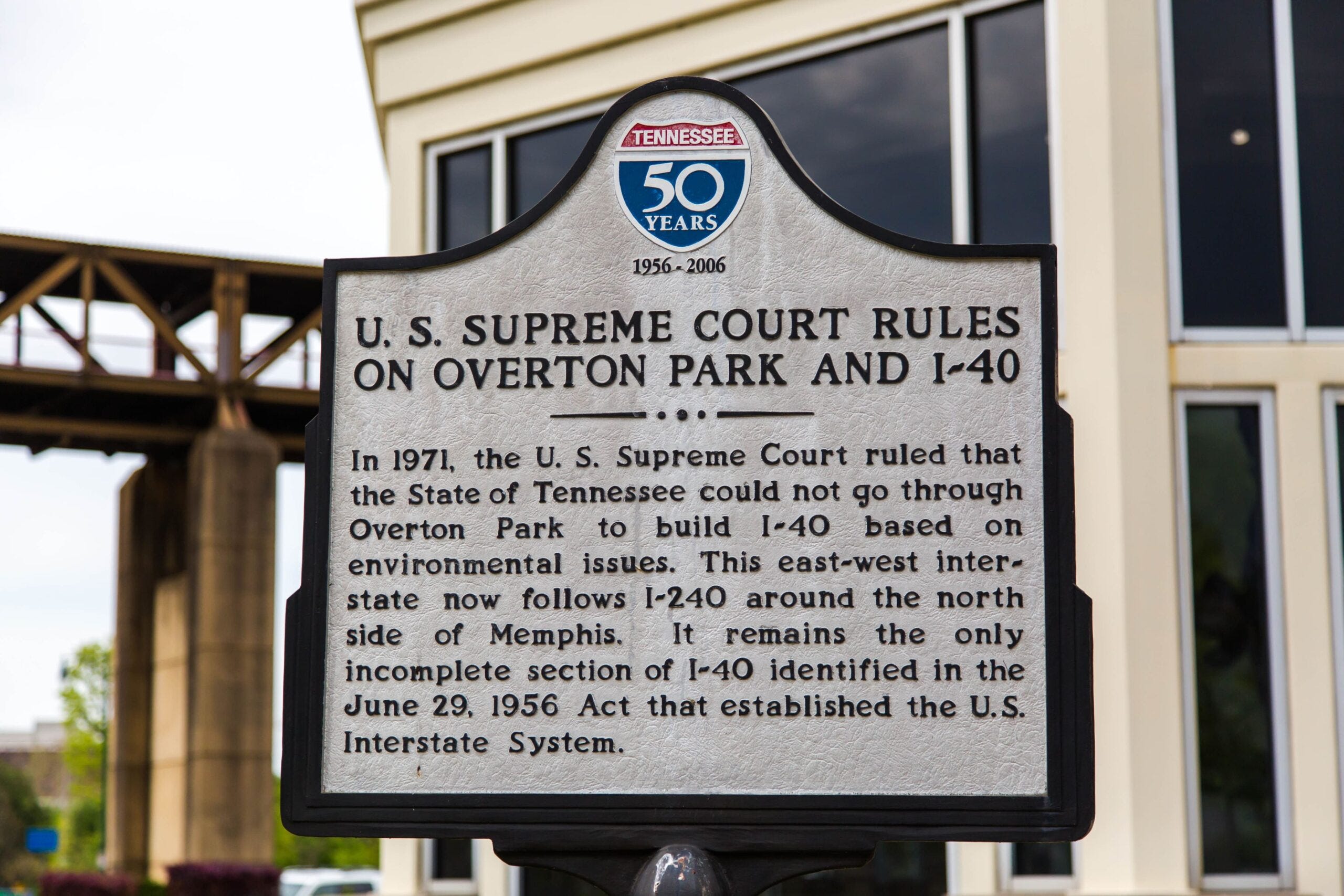
The third lever is litigation: how long, how often, and on what grounds challenges may proceed once a plaintiff is in court. Where standing determines who may enter the courthouse, litigation governs what happens once they are inside. Overton Park is the most widely cited example. In 1969, the Secretary of Transportation approved a route for Interstate 40 through Overton Park, a 342-acre park near the center of Memphis. The six-lane expressway would have required 26 acres of the park and separated its zoo from the rest of the grounds. Under federal law, the Secretary could approve a highway through a public park only if no “feasible and prudent” alternative route existed. A group of private citizens and conservation organizations, Citizens to Preserve Overton Park, brought suit, arguing that the Secretary had not made the required determinations. Unlike the plaintiffs in Lujan, they used the very land at stake, and the question was not whether they could sue but how closely a court should examine the Secretary’s decision. In 1971, the Supreme Court ruled in their favor and returned the case to the district court for a full review of the record. In 1973, the Secretary declined to approve the route, and the highway was never built through the park; several miles constructed nearby remain in use today as Sam Cooper Boulevard. The decision did more than settle one dispute. It established the basic framework that courts still use to review agency decisions, and once that framework existed, others used it: in the decades that followed, similar suits shaped roads, housing, and infrastructure across the country. Marc Dunkelman, in Why Nothing Works, describes this period as a turn toward “Jeffersonian” methods that push power down toward the people.
Because the levers are separate, they can be set separately. For permitting agencies, the most relevant levers are procedure and litigation, which determine which parts of the public can participate in the decision-making process, and when. To assuage concerns about costly delays in construction, standing could be narrowed in exchange for giving affected parties a voice in the decision-making procedure. The spectrum from submitting a public comment to bringing an agency before the courts for months can be understood as a spectrum from voice to veto, and democratic input may be most useful when it is early, inexpensive, and informative. It may be possible, then, to widen the front end of participation while narrowing the back end, through shorter windows for litigation, deadlines for review, and limits on how many times the same objection can be raised.
For questions of executive authority over public land, the most relevant lever is standing, and because standing is constitutional, it may not be resolved by legislation alone. Here the structure points to a different actor. The Constitution gives Congress the power to make “all needful Rules and Regulations” for federal property (Art. IV, § 3, cl. 2), so questions about executive authority over public land are also questions about Congress’s own powers. Congress has its own tools for addressing them: appropriations, oversight, and legislation. The World War II Memorial on the National Mall shows how directly those tools can work. When preservation groups sued to stop its construction at the Rainbow Pool site, Congress passed a 2001 law directing that the memorial be built there without delay and barring judicial review of the approvals for its site and design. An appeals court upheld the law, and the dispute ended. Using those tools requires staff and expertise, however, and House committee staff fell by about half between 1991 and 2015. The structure assigns Congress this role; what it lacks is the capacity to fill it. With greater capacity or political will, Congress would be better positioned to take up these questions directly, and the question of who else may sue might carry less weight.
Each of these situations, in other words, may call for a different solution. There may be no single point between centralization and decentralization at which the system can come to rest. The answer may lie less in finding that point than in attending to structure: recognizing that different decisions may call for different actors and different levers.